Key Takeaways
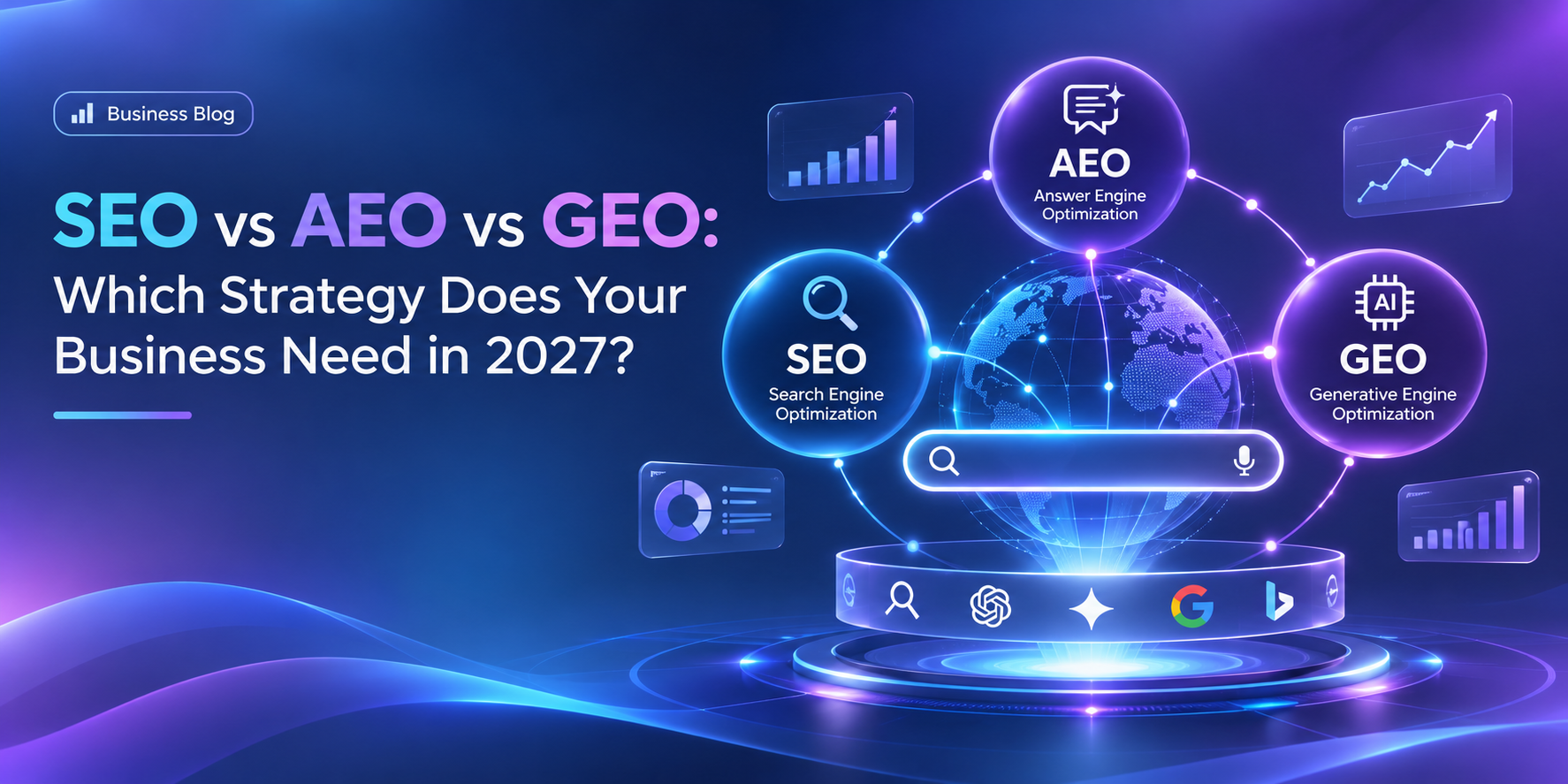
- SEO earns your pages a place in the regular Google and Bing listings.
- AEO shapes your content so it can be lifted into featured snippets, answer boxes and voice replies.
- GEO works on how often AI assistants name your brand and link to your pages.
- One set of basics powers all three: crawlable pages, accurate content, clear answers and a credible reputation.
- Success looks different for each. Clicks prove SEO, answer placements prove AEO and brand mentions prove GEO.
- Few businesses should pick just one. The better question is which one to fund first.
A buyer can now meet your brand in three very different places. They might spot your page on Google, read your answer in a snippet box or hear your name from ChatGPT. You can be visible in one place and missing from the others.
That is why many marketing teams feel unsure about where to spend. Comparing SEO vs AEO vs GEO is less about picking a winner and more about getting the order right. Your budget, your market and your buyers’ habits decide what comes first.
This guide gives you plain definitions, a real-world buyer example and a 90-day plan to get started.
SEO, AEO and GEO Explained
SEO (Search Engine Optimization)
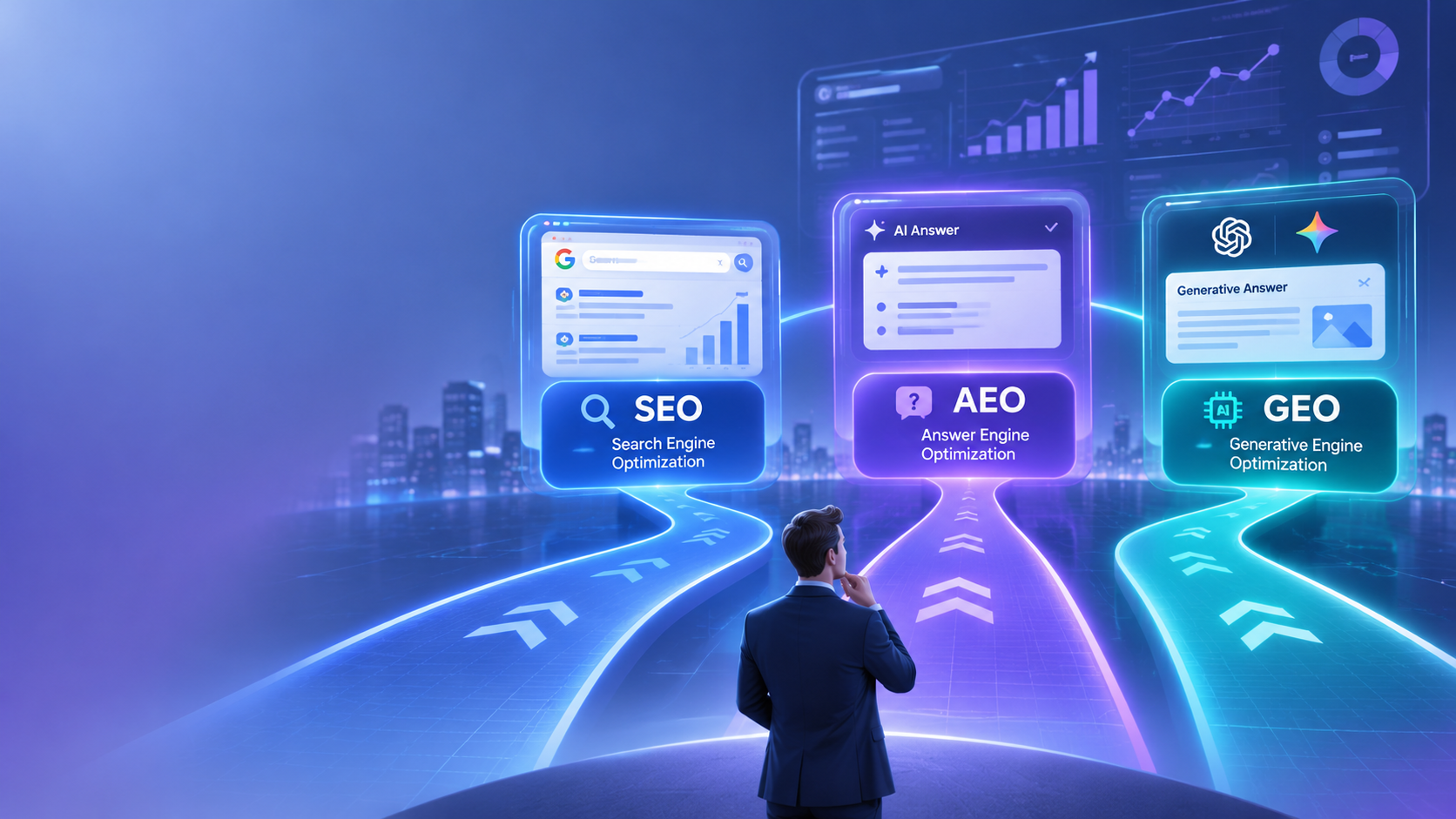
It is the work of getting your web pages to rank in standard search listings. It covers keywords, page speed, site structure, internal links and links from other websites. The reward is a click to your site.
AEO (Answer Engine Optimization)
It prepares your content to be shown as the answer itself. Google may display it in a featured snippet or a “People Also Ask” box. A voice assistant may read it aloud. The reward is being the first source people see, sometimes without a click.
GEO (Generative Engine Optimization)
It targets AI assistants that write full answers, like ChatGPT, Gemini, Perplexity and Google AI Overviews. The label comes from a 2024 research paper by academics at Princeton University and Georgia Tech. The reward is a brand mention or a cited link inside the AI’s reply.
One Buyer, Three Search Moments
Picture Sarah, who runs a 15-person accounting firm in Toronto. She needs payroll software and starts her research on a Monday morning.
First, she searches Google for “payroll software for small firms”. She scans the top listings and opens two vendor websites. This moment belongs to SEO.
Next, she types “how to calculate payroll deductions in Ontario”. Google shows a short, clear answer in a featured snippet taken from one vendor’s guide. That vendor has won an AEO moment, and Sarah now remembers its name.
Finally, she asks ChatGPT for three payroll tools suited to a small accounting firm, under CAD 300 a month. The AI names three brands and links to a review site. This is the GEO moment, and it can shape her final shortlist.
A vendor that only invested in SEO appeared once. A vendor that covered all three stayed in front of Sarah throughout her research.
How the Three Approaches Compare ?
| SEO | AEO | GEO | |
| Question it answers | Can people find my page? | Can my content be the quoted answer? | Does AI recommend my brand? |
| Where you show up | Organic listings on Google and Bing | Snippets, answer boxes, voice replies | ChatGPT, Gemini, Perplexity, AI Overviews |
| Content that suits it | In-depth pages built around search intent | Short definitions, steps, tables and FAQs | Expert explanations, comparisons, original data |
| Proof of success | Rankings, clicks, organic leads | Snippet and answer box wins | Mentions, citations, AI referral visits |
| Common blind spot | Ranking pages that never get quoted | Answers with no clear next step | Ignoring what reviews and forums say about you |
The Shared Foundation Behind All Three ?
The good news is that most of the work overlaps. In 2026, Google published guidance on optimising for its generative AI features. It mentions AEO and GEO as terms people may use, yet treats the work as part of SEO.
So the basics still carry the most weight:
- Pages that search engines and AI crawlers can access and index
- Content written by people with real knowledge of the subject
- Clear headings, short answers and a logical page structure
- Current facts, prices and service details
- A reputation supported by reviews, mentions and links
A well-run programme of SEO services covers most of this list. AEO and GEO then add sharper formatting and a wider view of your reputation.
What Changes When AI Writes the Answer ?
Overlap does not make the three strategies identical. Four shifts deserve your attention.
Ranking High No Longer Guarantees a Mention
Ahrefs examined 863,000 keywords in a March 2026 study. Only around 38% of AI Overview citations came from pages ranking in Google’s top 10. The rest came from pages outside the top 10.
Your Reputation Lives on Other Websites
AI assistants read far beyond your own site. Searchable’s analysis of Google AI Overviews citations lists YouTube (about 37%) and Reddit (about 21%) among the most-cited domains. Videos, forum threads and reviews can therefore shape how AI describes you.
Results Shift From One Query to the Next
Ask an AI tool the same question twice and you may get two different answers. A single check tells you very little. Patterns across many repeated checks are far more reliable.
Buyers Ask Fuller Questions
Sarah’s AI prompt included her team size, industry and budget. Content that addresses real conditions like these gives an AI more reasons to include you.
Want to see how your brand appears across Google and AI-generated answers?
Request an AI Visibility Review →
Which One Should You Prioritize ?
Ask yourself four questions. Your answers point to your first move.
- Can search engines reach and index your key pages? If not, start with SEO. Nothing else works until this is fixed.
- Do buyers ask you the same questions again and again? If yes, turn those answers into short, structured content. That is AEO.
- Do buyers compare several providers before choosing? If yes, check what AI assistants say about you and your rivals. That is GEO.
- Do review sites, directories and social profiles describe you differently? If yes, correct those details. This supports both GEO and local SEO.
Your industry also offers clues. Clinics and law firms often field many direct questions, so AEO can pay off early. SaaS companies and online retailers face heavy comparison shopping, so GEO deserves early attention. A brand-new website in any sector should secure SEO first.
A 90-Day Starting Plan
Days 1 to 30: Fix the base
Review indexing, page speed, mobile layout and broken links. Confirm your robots.txt file does not block important pages or AI crawlers. If your site struggles here, better website development may be the quickest win.
Days 31 to 60: Rework your top pages
Choose the ten pages that bring in the most leads. Add a direct answer under each main heading, plus a short FAQ section. Replace vague claims with specific facts, prices or examples.
Days 61 to 90: Track AI visibility
List 20 to 30 prompts your buyers would realistically ask. Test them monthly across ChatGPT, Gemini, Perplexity and Google. Record whether your brand appears, how it is described and which sources get cited.
Common Mistakes to Avoid
- Treating GEO as a replacement for SEO rather than an extension of it.
- Publishing thin “AI-friendly” pages that tell readers nothing new.
- Judging AI visibility from one screenshot or a single test.
- Trusting anyone who promises guaranteed AI placements. Google states that no one can guarantee a top ranking.
- Ignoring reviews and forum discussions just because you cannot control them.
Conclusion
SEO earns the click, AEO earns the quote and GEO earns the recommendation. Businesses that appear at all three moments give buyers more chances to choose them. Start with whichever gap costs you the most enquiries today. If you are unsure where that gap lies, speak with our search team for a second opinion.
Ready to build one search plan that covers SEO, AEO and GEO for 2027?
Talk to Matrix Marketers →Frequently Asked Questions
Does Google treat AEO and GEO as separate from SEO?
Not really. Google’s 2026 guidance on generative AI search treats both as part of SEO. The new labels help marketers discuss new goals, but the core work stays the same.
Which of the three strategies shows results fastest?
AEO can move quickest, since reformatting existing pages may earn snippets fairly soon. SEO usually needs months of steady effort. GEO depends on your wider reputation, so it tends to build gradually.
Do I need separate content for AI search engines?
No. One well-structured page can serve readers, search engines and AI assistants at once. Focus on clear answers, accurate details and genuine expertise instead of duplicate “AI versions” of pages.
Is GEO relevant for local businesses?
Yes. People ask AI tools for local suggestions, such as a good dentist nearby. Consistent business details, recent reviews and clear service pages help AI tools describe you correctly.
How often should I check my AI visibility?
Monthly checks suit most businesses. Use the same prompts each time so you can spot genuine trends. Check more often after major site changes or a product launch.